
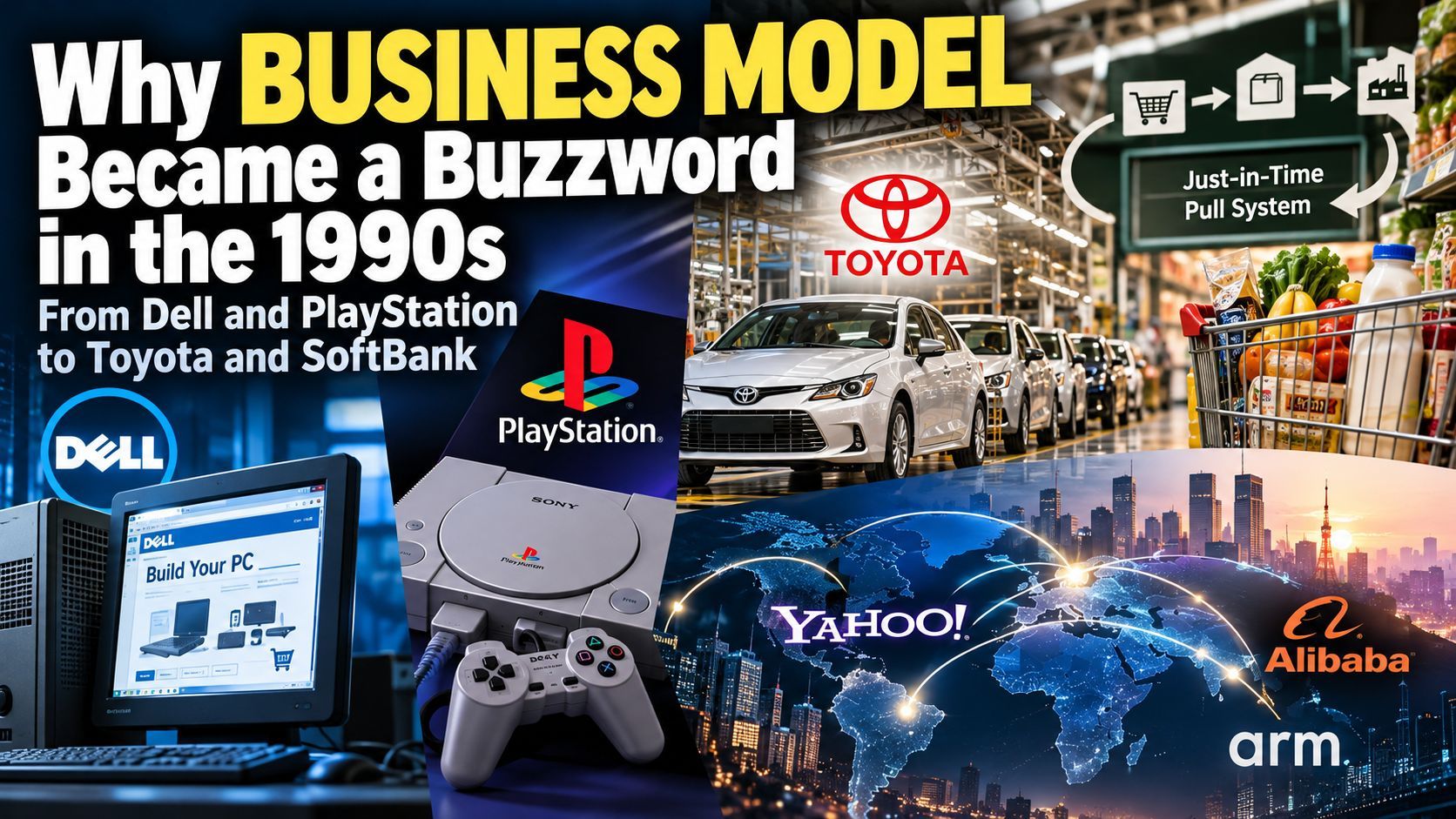
Why "Business Model" Became a Keyword in the 1990s: From Dell and PlayStation to Toyota and Softbank
Why did "business model" become a keyword? This article traces the term's earliest uses in the Japanese business press: the 1995 coverage of Dell and its direct sales plus build-to-order model, the 1997 feature on how PlayStation rejected Nintendo's business model, and later talk of an existing model no longer working as Japan's chip industry came under pressure. It then turns to Toyota — the two pillars of Just-in-Time and jidoka, the flaws of push production, the pull system inspired by American supermarkets, and why Ford-style mass production was overkill in Japan. It closes with Masayoshi Son's time machine management and the idea that there is no single right angle on a business model.

Why "Business Model" Became a Keyword in the 1990s: From Dell and PlayStation to Toyota and Softbank
The word's rise is itself a sign of accelerating change
The concept of a "business model" is generally thought to have taken shape and spread from the 1990s onward. It first came in for serious discussion in a very specific context: how the spread of the internet would change the existing retail industry.
The internet made industrial structures change far faster than before. Methods that had worked a few years earlier now had to be re-examined to see whether they still held. That uncertainty is what turned "business model" into something that had to be discussed. In other words, the term mattered not because it was fashionable, but because the external environment was changing so quickly that old methods could stop working at any time.
How Japanese business media first used the term
Looking back at Japan's business press reveals a telling detail.
The Nikkei (Nihon Keizai Shimbun) began using "business model" in earnest around 1995. The earliest clearly verifiable instance appears in an article about Dell Technologies. Until then, selling PCs through electronics retailers or distributors had been the norm. Dell grew rapidly with two weapons: direct sales to corporate customers and low-cost build-to-order production. In an interview, founder Michael Dell described his company as a "unique business model," and those words survive on the page.
Another clearly verifiable use comes from a special feature in August 1997. Discussing how Sony Computer Entertainment, part of the Sony Group, took on Nintendo and made the first PlayStation a success, the article used the phrase "a PlayStation strategy that rejected Nintendo's existing business model."
Later, as Japan's semiconductor industry — once dominant worldwide — came under attack from US and Taiwanese rivals, the term appeared again in the context of "the existing business model no longer applies."
Whether in the Nikkei or in Weekly Toyo Keizai, "business model" first showed up around the IT industry. That is a fascinating point.
What Toyota learned from the supermarket
Studying a predecessor's example and then imitating it may sound vaguely negative, but it is nothing of the kind.
In *The Management Science of Imitation: Great Companies Are Born from "Mane"* (模倣の経営学——偉大なる会社はマネから生まれる), Tatsuhiko Inoue cites Toyota Motor as an example. The "mane" in the title is not money — it is "mane" as in copying, that is, imitation. What pushed Toyota to number one in the world was the Toyota Production System, which eliminates waste relentlessly.
In his book *Toyota Production System*, Toyota's Taiichi Ohno explains that the system rests on two pillars: Just-in-Time and jidoka ("autonomation").
Just-in-Time means "the necessary item, at the necessary time, in the necessary amount." And "jidoka" — written with the character 働, which carries the person radical 亻 rather than the ordinary 動 — means that when a machine develops an abnormality it stops automatically, so no one has to watch it constantly. That is how it saves labor.
The traditional system "pushes"
To see why Just-in-Time matters, you first have to look at the problem with the traditional approach. Making a car, then and now, runs through these steps: pressing steel into shape, welding the parts together, painting, assembling components and engines, and finally inspection.
The traditional system was a "push" system: the earlier process worked steel into parts according to a production plan and supplied them to the later process, which then painted and assembled. But defects, rework, and equipment failures inevitably occur along the way, so the production plan is constantly changing.
If something goes wrong in painting, the assembly department downstream is short of parts and its line stops. Meanwhile, the upstream department keeps turning steel into parts according to plan, piling up inventory that is neither necessary nor urgent. Keep that up and production efficiency deteriorates, which drags down business performance.
Reversing the flow: the pull system
When Ohno conceived Just-in-Time, he reversed the entire flow. Instead of the earlier process pushing to the later one, the later process takes from the earlier one only what it needs, when it needs it. Information about which parts the final assembly line used is passed back to the preceding process, which then makes only what was taken.
That way, the earlier process makes only as much as the later process needs, cutting unnecessary inventory and the labor of managing it.
The hint came from American supermarkets. Ohno wrote that he learned of a system in US supermarkets for buying "the necessary thing, at the necessary time, in the necessary amount," and that this gave him the idea for the pull system. Walk into a supermarket and you find a huge variety of food; you can buy everything you need today, in the amount you need, in one place. Car production works the same way: if the later process takes only the parts it needs, when it needs them, from the earlier process, there is no waste for the later process.
Of course, making Just-in-Time work was not easy. It required leveling production and a mechanism for exchanging information, such as kanban cards. It took ten years at Toyota's own main plant alone, and even longer to extend the system to suppliers.
It may sound obvious today, but Ohno began working on this production system with the supermarket as his model in the late Showa 20s — around 1950 to 1955. Supermarket operators in Japan only began to be founded in 1956 and 1957. At the time there was no such thing as a modern supermarket; buying from the neighborhood greengrocer or fishmonger was the norm. Ohno heard about American supermarkets secondhand and, through experience with various methods, applied the idea to reforming his own production line.
Ford's mass production was optimal in the US, excessive in Japan
The foundation of the modern auto industry — mass production through the assembly line — was built by America's Ford Motor Company. That approach may have been optimal in the US, but in Japan it was overkill.
Depending on how you count, in the first half of the 1950s the US produced roughly 5 million vehicles a year, while Japan produced only tens of thousands — a gap of more than 100 times. That is why Toyota, adapting to Japan's small-volume, many-variety market, did not choose Ford's belt conveyor — the push system — but instead switched its thinking to the Just-in-Time pull system: taking what it needed, in the amount it needed, the way you shop in a supermarket.
Toyota imitated Ford's production system while learning its principles from the model, resolving the contradictions that arose in practice, and refining the mechanism — ultimately building a system its rivals could not easily copy. Even a system born from imitation can reach the level of the original. That is what is truly impressive.
Masayoshi Son's "time machine management"
Another example is "time machine management," created by SoftBank Group's Masayoshi Son. The method is to bring advanced examples from the US and elsewhere into Japan and then spread them around the world, maximizing profit.
Concretely, a SoftBank subsidiary in the US invests in promising companies; if they look likely to succeed, it puts in more money and supports them all the way to a Nasdaq listing. That produces the first unrealized gain. SoftBank then sets up joint ventures in Japan or Europe, introduces the business model there, or takes the venture public to earn a profit.
The starting point was an investment in Yahoo in the US. In 1995, Son invested in Yahoo, which had been founded by Stanford University students. Yahoo's share price then soared, bringing SoftBank at the time close to 1 trillion yen in profit and giving rise to the joint venture Yahoo Japan — today's LINE Yahoo, a major IT company with a market value of 3 trillion yen.
Through portal sites, search, e-commerce, auctions, QR codes, PayPay, and other businesses, LINE Yahoo has grown by bringing advanced overseas examples to Japan. Son has also invested in world-leading companies such as China's Alibaba Group and the UK's ARM, earning enormous returns. He has booked huge losses on ventures such as the co-working company WeWork, but that does not change the fact that he is an excellent investor.
There is no single correct angle on a business model
Finally, there is no single right answer to the question of what angle to use when looking at a business model.
A book in which a manager talks about his own company may describe in detail how the business was built and what made it different. A book by a consultant will explain the industry's particular competitive environment and business structure. In recent years, books by accountants that read business models out of the balance sheet (BS) and profit-and-loss statement (PL) have also become popular. All of them explain business models from different sides.
This book, *Mouke no Shikumi* (How Money Is Made), edited by the Japan Company Handbook (会社四季報) Industry Map editorial team and supervised by Tatsuhiko Inoue, follows a framework of "defining the business model" and "transactions," treating the various relationships between parties as nine models. Drawing on the perspective honed through reporting for the Japan Company Handbook and on the diagramming know-how of the Japan Company Handbook Industry Map, it explains which industries are worth watching and how they make their money. This framework around "transactions" is defined as rigorously as possible so that anyone can use it freely.
That is the overall picture. From here, let us work through the cases one by one and study the mechanics of making money.