
The Two Faces of the Make-and-Sell Model: Strengths and Limits Seen Through an Auto Parts Maker's 10% Margin
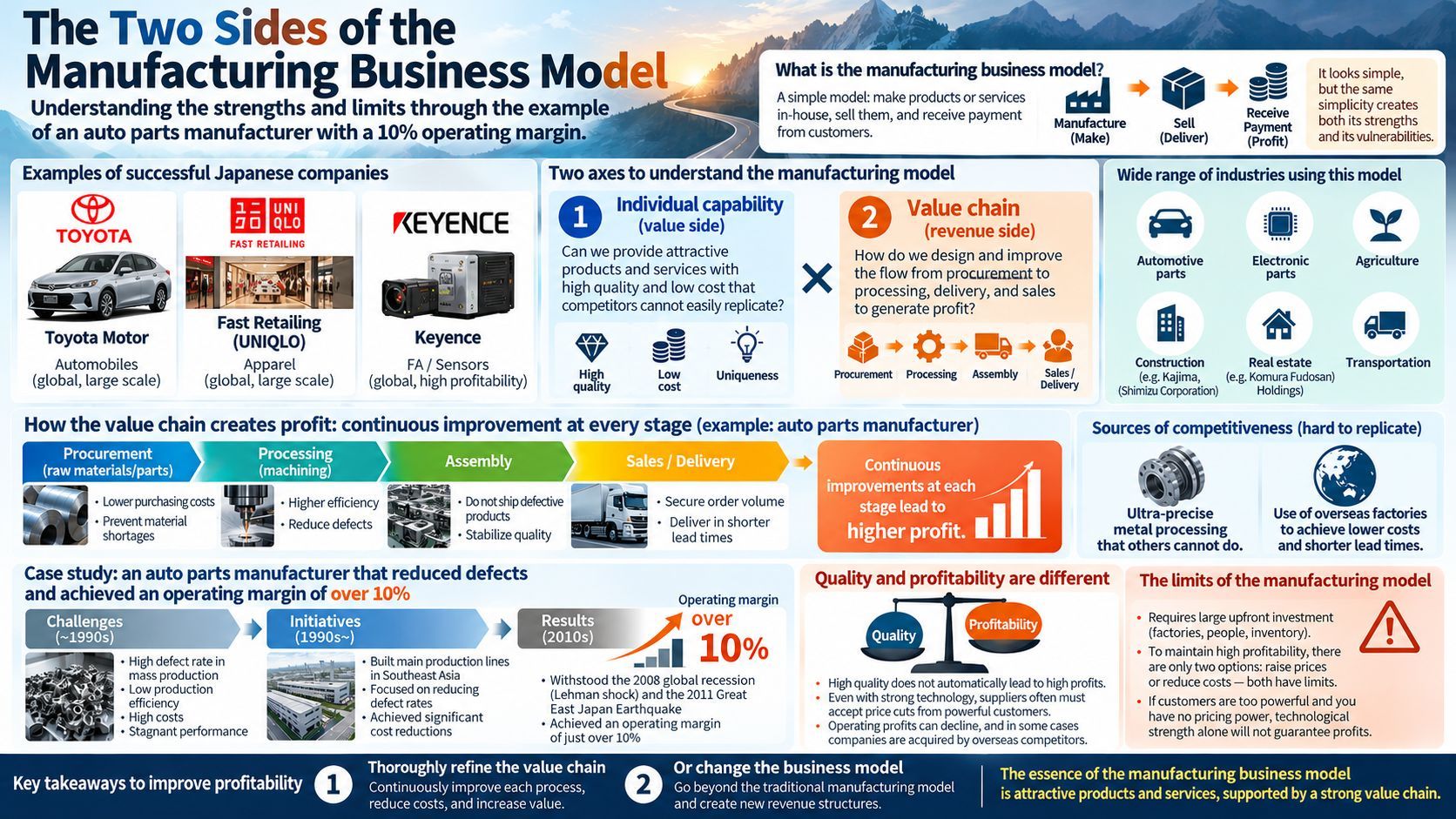
The make-and-sell model looks simple: a company manufactures and sells its own products and is paid by customers. Yet its strengths and its fragility come from the same place. Two axes matter: standalone strength—high quality, low cost, and things rivals cannot do—and the way revenue is earned across the value chain of procurement, processing, and delivery. One ultra-precision parts maker stagnated on mass-production defects, moved its main line to Southeast Asia in the 1990s, and improved defects so thoroughly that it held an operating margin above 10 percent through the 2008 recession and the 2011 earthquake. But quality and profit margin are different things: a supplier that cannot refuse price-cut demands does not recover, and was acquired. The only ways out are to overhaul the value chain or change the model.

The Two Faces of the Make-and-Sell Model: What a 10% Operating Margin at an Auto Parts Maker Reveals About Its Strengths and Limits
The make-and-sell model (製造販売モデル) sounds simple enough: a company manufactures a product or service itself, sells it, and receives payment from the customer. It is almost too simple to need explaining. But precisely because it is simple, the model's strengths and its fragility tend to come from the same place.
This series looks at three Japanese companies as case studies: Toyota Motor, Fast Retailing, and Keyence. They operate in different industries, at different scales, and with different levels of profitability, yet all three are global companies that represent Japan. The question is this: why can their growth rates and profit margins run so high? The answer is not in the word "manufacturing" but in two axes inside the model.
Two axes: standalone strength and the value chain
To understand the make-and-sell model, you need to look in two directions.
One is "standalone strength": can the company offer attractive products and services at high quality and low cost, at a level competitors cannot match? That is the value side.
The other is how it earns revenue: within the value chain, it procures raw materials and components, processes them, and delivers them, forming a chain that runs from cost to price. Whether a company makes money depends on how that chain is designed and how each link is improved.
Companies that use this model reach beyond manufacturing into agriculture, construction, and transportation. Among the examples cited are Komura Real Estate Holding (小村不動産ホルディング), Kajima, and Shimizu Corporation. The most easily recognizable cases are the many firms in industries such as auto parts and electronic components. Put the other way around: if the products and services do not rest on a solid business model, a company cannot sustain its competitiveness for long.
How a value chain becomes profit: continuous improvement at every stage
Take an auto parts maker. Its job is to procure various raw materials, process them, assemble them, and sell them—forming a single value chain. To generate more profit, it has to keep improving every step: how to procure more cheaply, how to avoid shortages and keep defective products from shipping, how to organize production efficiently, and how to sell in volume. Only when these improvements stack up across every stage does profit appear.
Competitiveness usually comes from two things rivals find hard to copy. One is mastery of high-precision metal processing that other companies cannot manage. The other is using overseas factories to deliver products at lower prices and shorter lead times. In other words, the model works when a company can offer what others cannot while driving down costs along the value chain.
A case where defect rates came down and margins went up
Around 2010, the author visited an auto parts manufacturer. The company excelled at ultra-precision components. Its business model was extremely simple: deliver a specified quantity at the price the customer specifies, and receive payment.
The trouble lay precisely in the "ultra-precision" part. In mass production, ultra-precision components inevitably produce a large number of defects. When defects pile up, productivity does not rise and costs do not fall. Performance stagnated for years.
In the 1990s, the company set up its main production line in Southeast Asia and concentrated on reducing defects. The cost-cutting effort was aggressive, and it eventually succeeded; performance surged. Through the recession after the 2008 Lehman shock and the 2011 Tohoku earthquake, while many peers and other companies struggled, this auto parts maker achieved an operating margin just above 10 percent.
Quality and profit margin are two different things
Now comes the other face of the model.
From a business-model perspective, quality and profit margin are two different things. The make-and-sell model depends on customers buying again and again. And because it is a manufacturing business, the entrepreneur must build factories, hire people, and prepare materials—requiring substantial investment. To grow, the company must sell volume, increase sales, cut costs, earn profit, and invest again. To sustain a high margin, there are only two paths: raise prices or cut costs. And both have limits—persuading customers to accept higher prices is hard, and cost cutting cannot go on forever.
In reality, not every auto parts maker can sustain such margins. Even with strong technical capability and competitiveness, when the automaker that is its customer demands price cuts, a supplier often cannot refuse. Operating profit gradually declines, performance falls, and it does not recover for a long time; a few years later, the company was acquired by a European electronic components maker.
This is arguably the limit of the make-and-sell model: when the customer is strong enough and the supplier has no pricing power, technical strength and competitiveness do not automatically turn into profit.
To change course, you must change the value chain—or the model
The quality of Japanese manufacturing is among the best in the world, and Japanese companies' drive to pursue technology and quality is genuinely high. But as the case above shows, that drive alone does not guarantee profit.
There are only two ways to change the situation and lift the margin: thoroughly polish your own value chain, or change the business model. The essence of the make-and-sell model remains attractive products and services, and the value chain that supports them.
Next time, we will continue with Toyota Motor as the example.