
Where Profit Comes From: Toyota's Cost Reduction and Uniqlo's SPA Model
Toyota, Honda, and Nissan run the same manufacturing-and-sales model, yet Toyota's margins are higher. Part of the reason is its commitment to cost reduction while working with keiretsu suppliers such as Denso and Aisin; part is the scale effect of 11.51 million vehicles produced worldwide in 2023. The second case is Fast Retailing (Uniqlo), known for an SPA model that handles planning, manufacturing, and sales in-house, cutting out intermediate margins and reaching global scale with a staple-product strategy opposite to Zara's. This article compares the two industries through one question: how does a company turn its cost structure into a competitive advantage?

Where Profit Comes From: Toyota's Cost Reduction and Uniqlo's SPA Model
A single car uses more than 30,000 parts. That puts the finished-vehicle maker at the top of a long, wide supply chain, with influence over industries ranging from materials to electrical components. Toyota, Honda, and Nissan run essentially the same business — building new cars in-house and selling them through affiliated dealers — yet their profit margins are not the same.
Same manufacturing-and-sales model, so where does the gap come from?
Where Toyota Saves
Looking at the breakdown of costs, Toyota's labor and R&D expenses are lower than Honda's and Nissan's, and its parts procurement costs are kept tighter as well. One reason is how thoroughly Toyota pursues cost reduction in parts procurement.
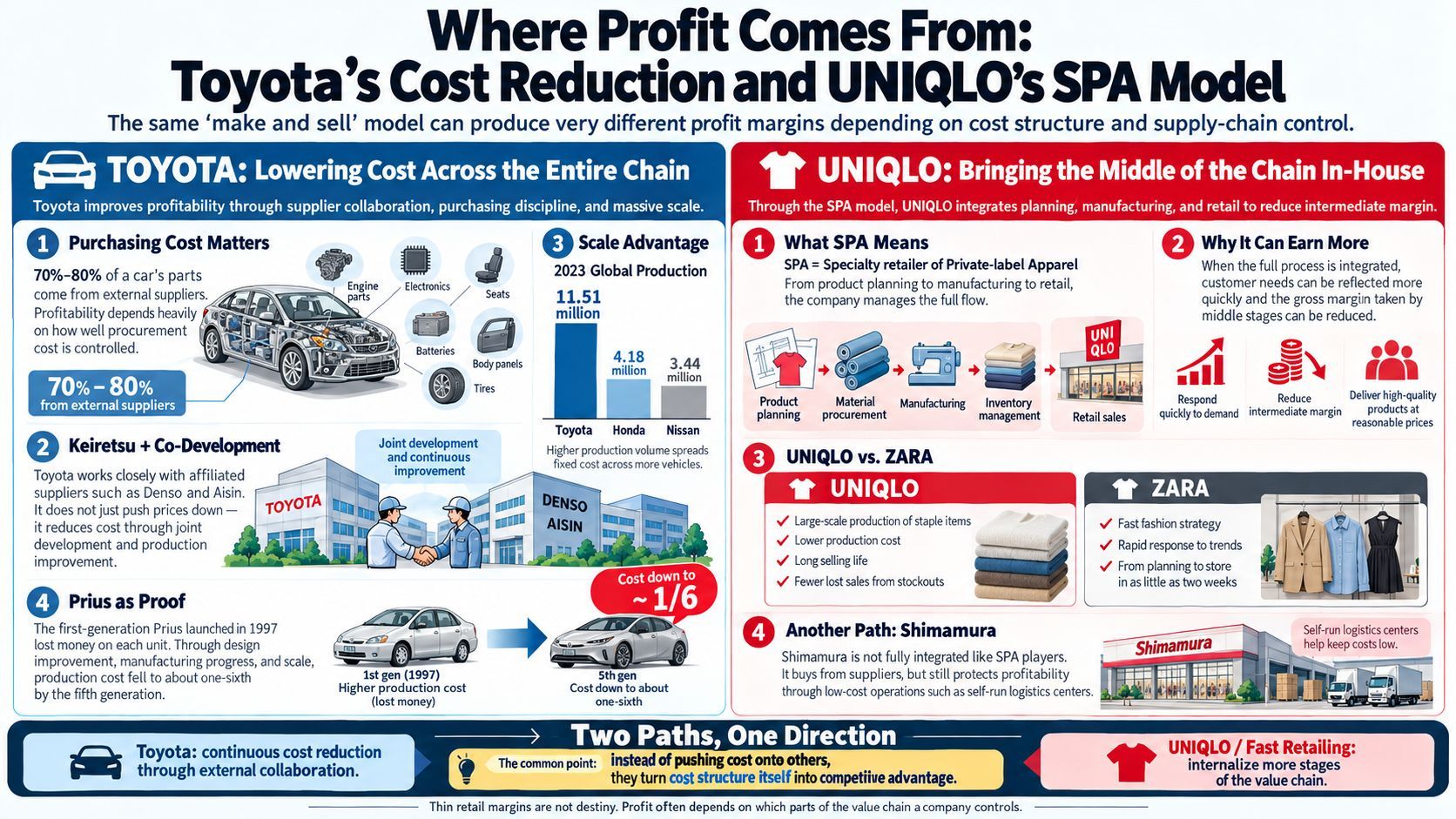
Seventy to eighty percent of a car's parts come from outside suppliers, so how much profit survives depends heavily on how far procurement costs can be compressed. Demanding a lower price is no secret. The hard part is keeping suppliers willing to cooperate afterward. If parts makers are only ever handed one-sided price cuts, the business stops making sense for them.
Keiretsu: Push on Price, but Develop Together
Toyota's approach is to keep capital ties in place. The keiretsu — the network of parts makers with capital links to Toyota, such as Denso and Aisin — is still maintained today. Toyota is demanding with its suppliers, but it also works alongside them in development and on the production floor, refining products through repeated joint engineering (suri-awase) and thereby achieving substantial cost reductions.
In other words, Toyota is not just squeezing the unit price of individual transactions; it is squeezing the cost of the whole chain. While asking for lower prices, it also drives costs down for real through joint development and process improvement.
Scale: 11.51 Million Units vs. 3.44 Million
The other pillar is production scale.
In 2023, Toyota produced 11.51 million vehicles worldwide, Nissan 3.44 million, and Honda 4.18 million — a difference of an order of magnitude. Once parts are shared, the more vehicles you build, the lower the fixed manufacturing cost per vehicle. Other automakers are also pushing parts sharing, but they cannot match Toyota's scale effect.
This is roughly how the gap in earning power between Toyota and its peers in the auto business comes about.
The Prius: From Losing Money on Every Sale to Roughly One-Sixth the Cost
Has this approach been proven? A Shikiho reporter's column holds up the Prius as a textbook success story in cost reduction.
When the first-generation Prius reached the market in 1997, the loss grew with every car sold. Toyota then steadily sharpened its competitiveness through design improvements, advances in production technology, and the accumulated benefits of scale. According to that column, by the fifth generation — the current model — the manufacturing cost has fallen to roughly one-sixth that of the original.
Uniqlo: Pulling the Middle Steps In-House
The second case is Fast Retailing — Uniqlo. Its key point is handling everything from product planning to manufacturing and sales in-house: the SPA (manufacturing-retail) model.
The apparel supply chain is long. It starts with product planning, moves through material production and processing and sewing, and ends with finished goods reaching consumers. The industry generally relies on a horizontal division of labor, with each step handled by a specialist company. The more steps there are, the more intermediate margin accumulates, so retailers downstream — buying in finished goods — have long been stuck with thin margins and high volume: because the profit per item is small, you have to sell a lot.
SPA companies go the other way: planning, manufacturing, and sales all in-house. The leading examples are Spain's Inditex, which runs Zara, and Fast Retailing, which runs Uniqlo. By integrating the entire process, they can reflect customer needs in the product in finer detail and cut the intermediate margins that used to arise at each step.
Uniqlo and Zara: Same Model, Opposite Playbooks
Both use the SPA model, yet Uniqlo's and Zara's product strategies are nearly opposites.
Uniqlo mass-produces staple items to hold down production costs, so it can still turn a profit at relatively low prices. Staples can be sold over a long period, which also minimizes the opportunity loss from stockouts. The company is no less serious about product strength: it develops functional innerwear jointly with material suppliers.
Zara, by contrast, is built on fast fashion — the latest trends at low prices. To reflect trends quickly, Inditex can take a product from the start of planning to store shelves in as little as two weeks.
Shimamura: A Different Path Without Integration
In Japan's domestic apparel industry, the company with sales second only to Fast Retailing is the clothing chain Shimamura. It sells goods purchased from suppliers — a buying model. Compared with an SPA, its procurement costs are higher, but it secures profitability through its own low-cost operations, such as running its own distribution centers.
Two Paths, One Direction
Toyota and Fast Retailing are in completely different industries, and their methods are hardly similar: one grinds costs down bit by bit within existing keiretsu and supplier relationships, while the other pulls the entire chain from planning to sales inside the company. Yet the direction is the same. Neither expects to pass costs on to someone else; both turn their cost structure itself into a competitive advantage.
That also suggests thin margins and high volume are not retail's fate. They are more like the result of profit being left behind in other steps of the chain.