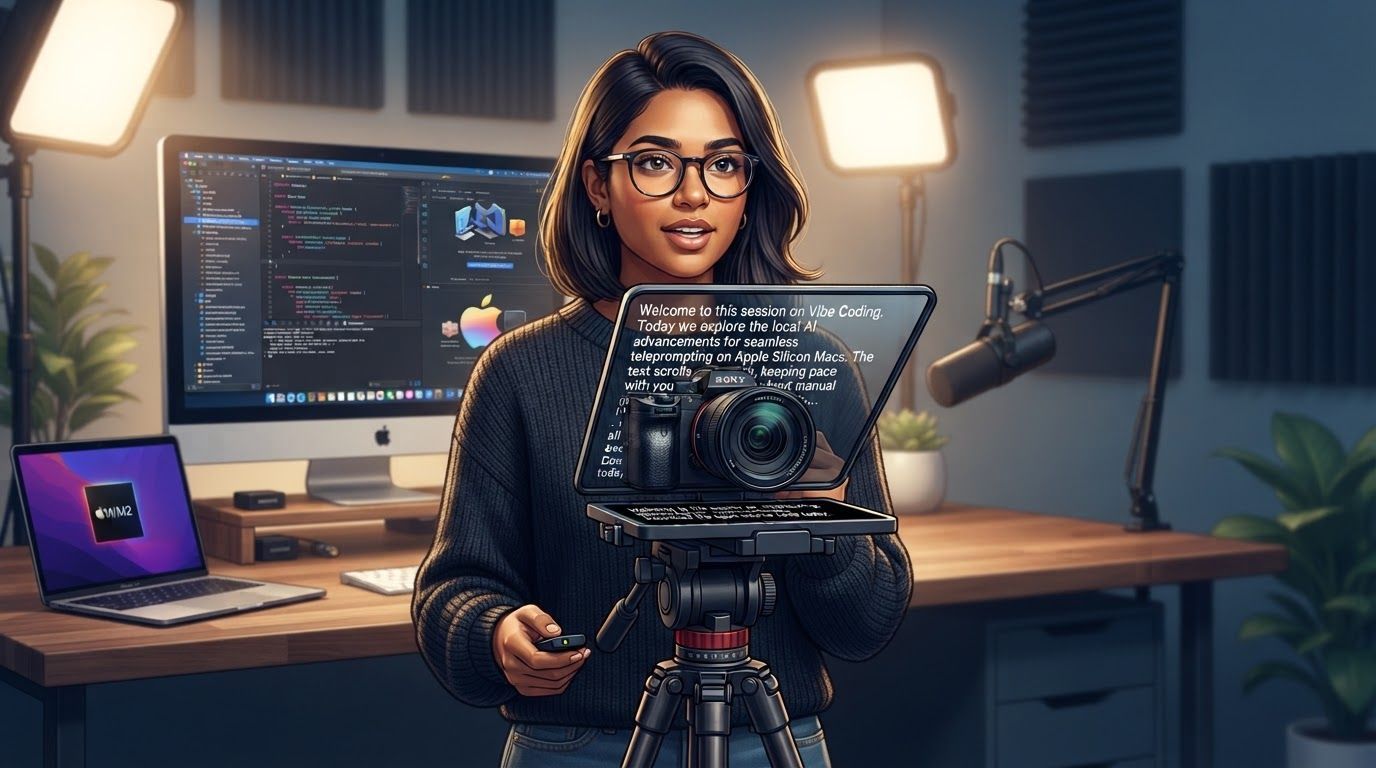
A Mac teleprompter built with Vibe Coding: a local AI model advances the lines automatically, so you don't scroll by hand while talking. Processing stays on the device and footage needn't go to the cloud, though it only runs on Apple silicon Macs. Beauty filters complete the recording workflow, and the code is open source to download and modify.
A Mac teleprompter built with Vibe Coding: a local AI model advances the lines automatically, so you don't scroll by hand while talking. Processing stays on the device and footage needn't go to the cloud, though it only runs on Apple silicon Macs. Beauty filters complete the recording workflow, and the code is open source to download and modify.
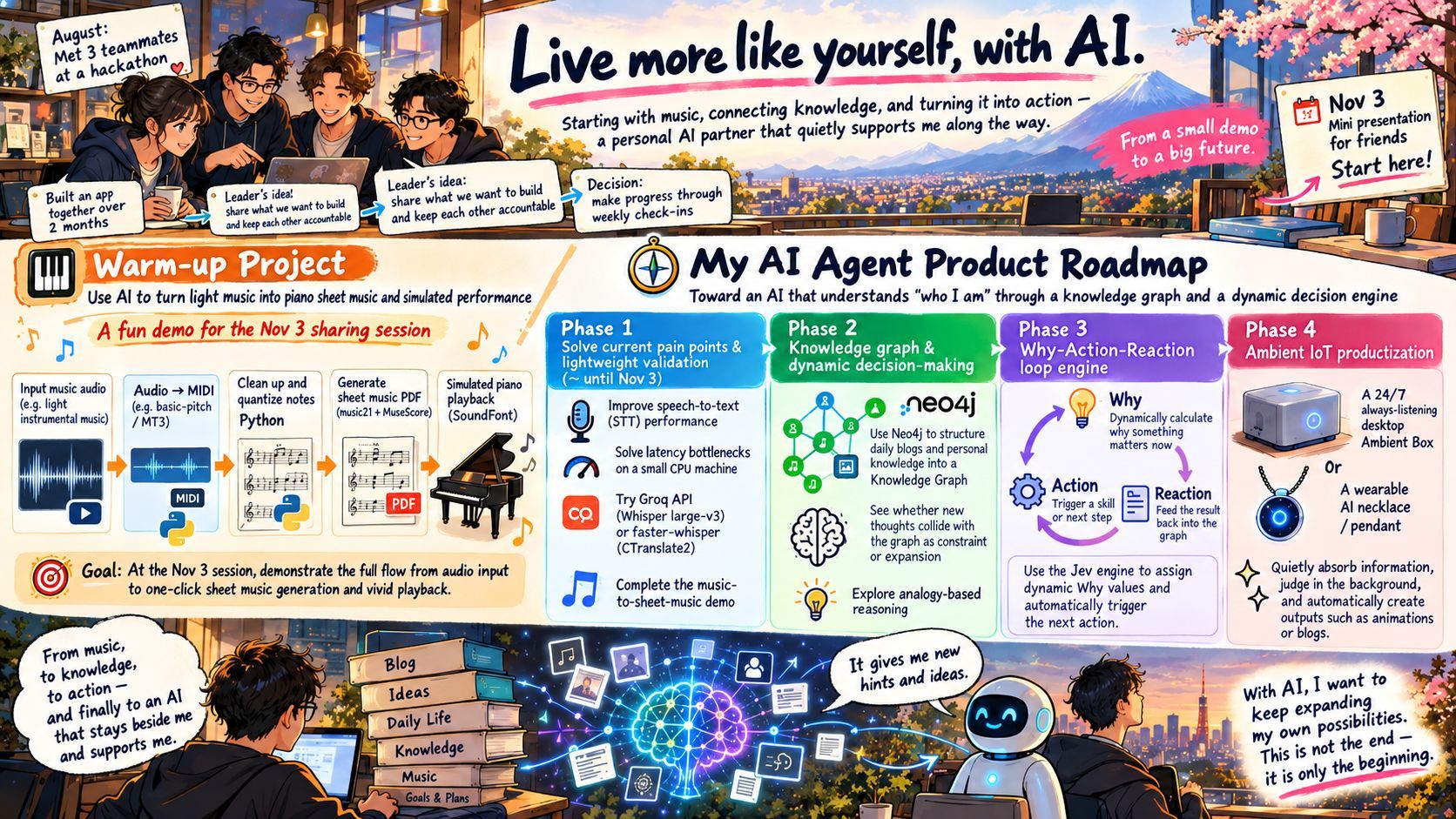
Ahead of a small November 3 session with friends, I'm building a warm-up demo that turns light music into piano sheet music and simulated playback, validating the audio-to-MIDI pipeline. Then I return to the core product: a Neo4j knowledge graph that gives an agent a dynamic “why,” developed across four phases — faster STT, knowledge collision, a Why-Action-Reaction loop, and Ambient IoT hardware. The post also records the open questions and the weekly cadence I'm using to keep moving.
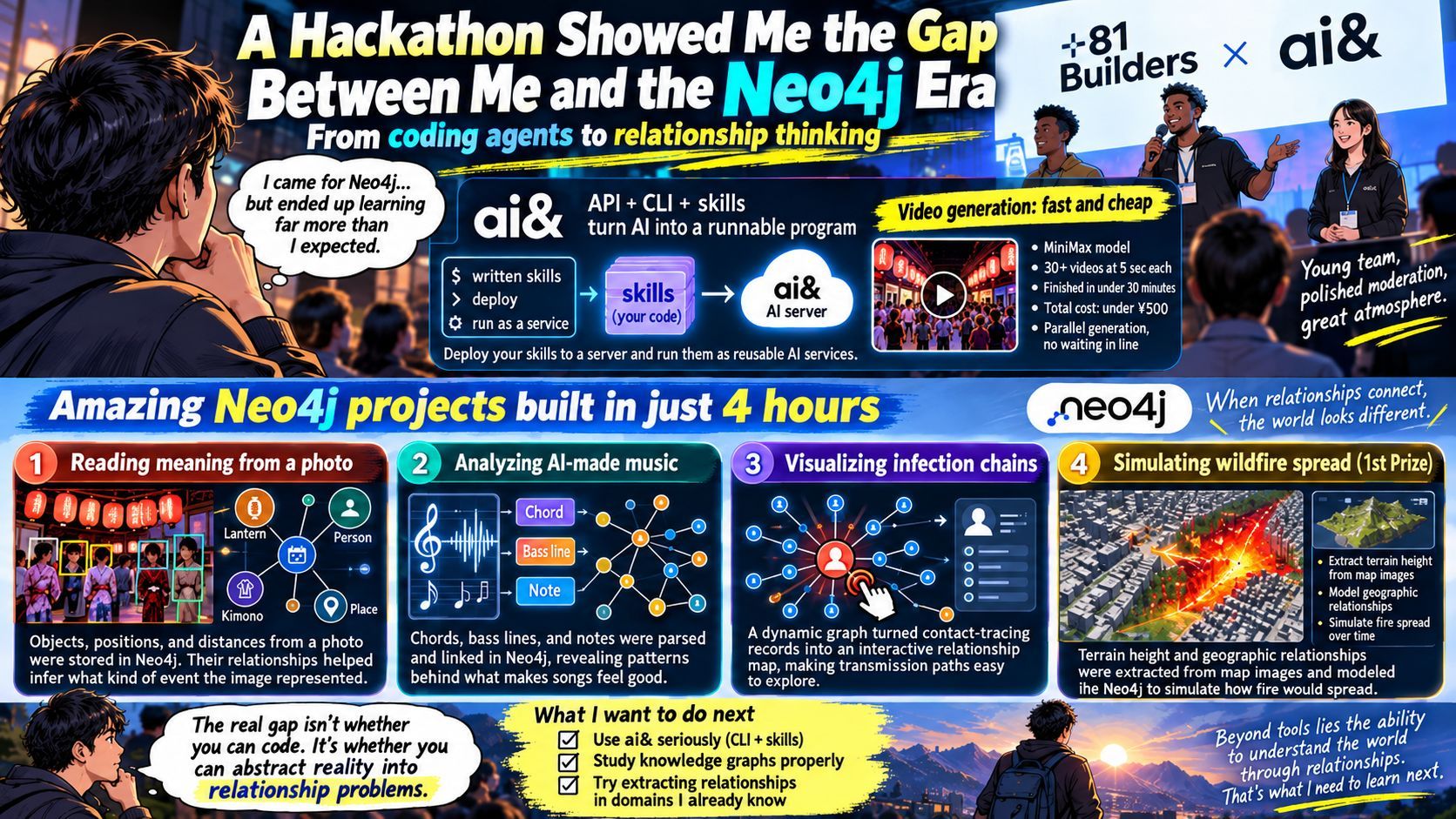
I joined a hackathon hosted by +81 Builders , where ai& showed how its CLI and skills turn an AI service into a deployable server, and MiniMax video generation proved fast and inexpensive. The bigger shock was what participants built with Neo4j in four hours: relationship analysis of photos, music analysis, a dynamic contact-tracing graph, and a fire-spread simulation. The experience made me realize that coding-agent fluency is no longer enough, and that I need to learn knowledge graphs.
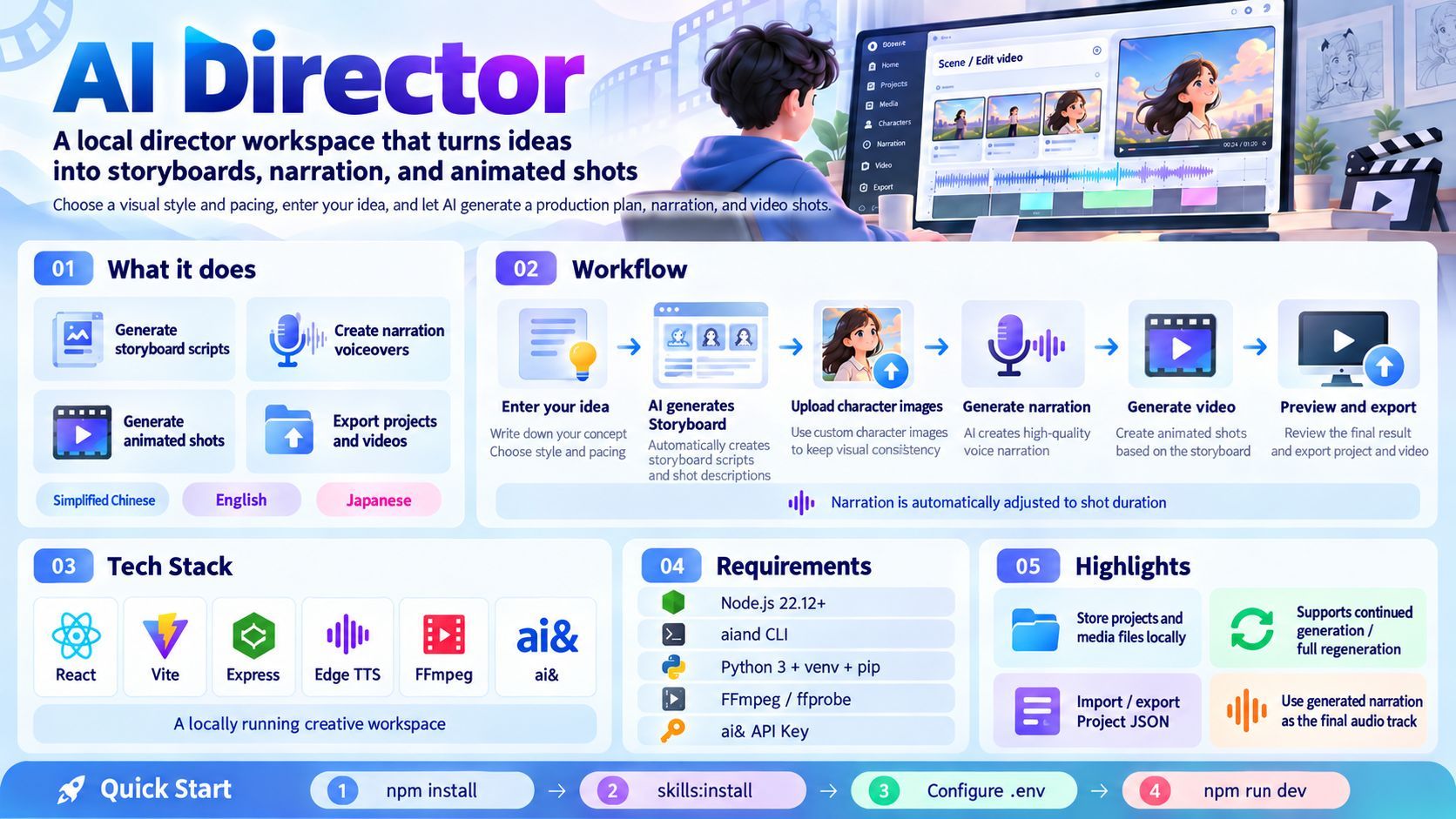
AI Director is a local director's workspace that breaks an idea into a storyboard, characters, voiceovers, and shots. It constrains AI output with validated project JSON, fits Edge TTS narration to each shot's duration, and generates video through ai&'s MiniMax H3. This article walks through the production flow, timeline handling, the boundaries of paid tasks, the local-first data design, and the engineering choice to load and validate the Skill explicitly.
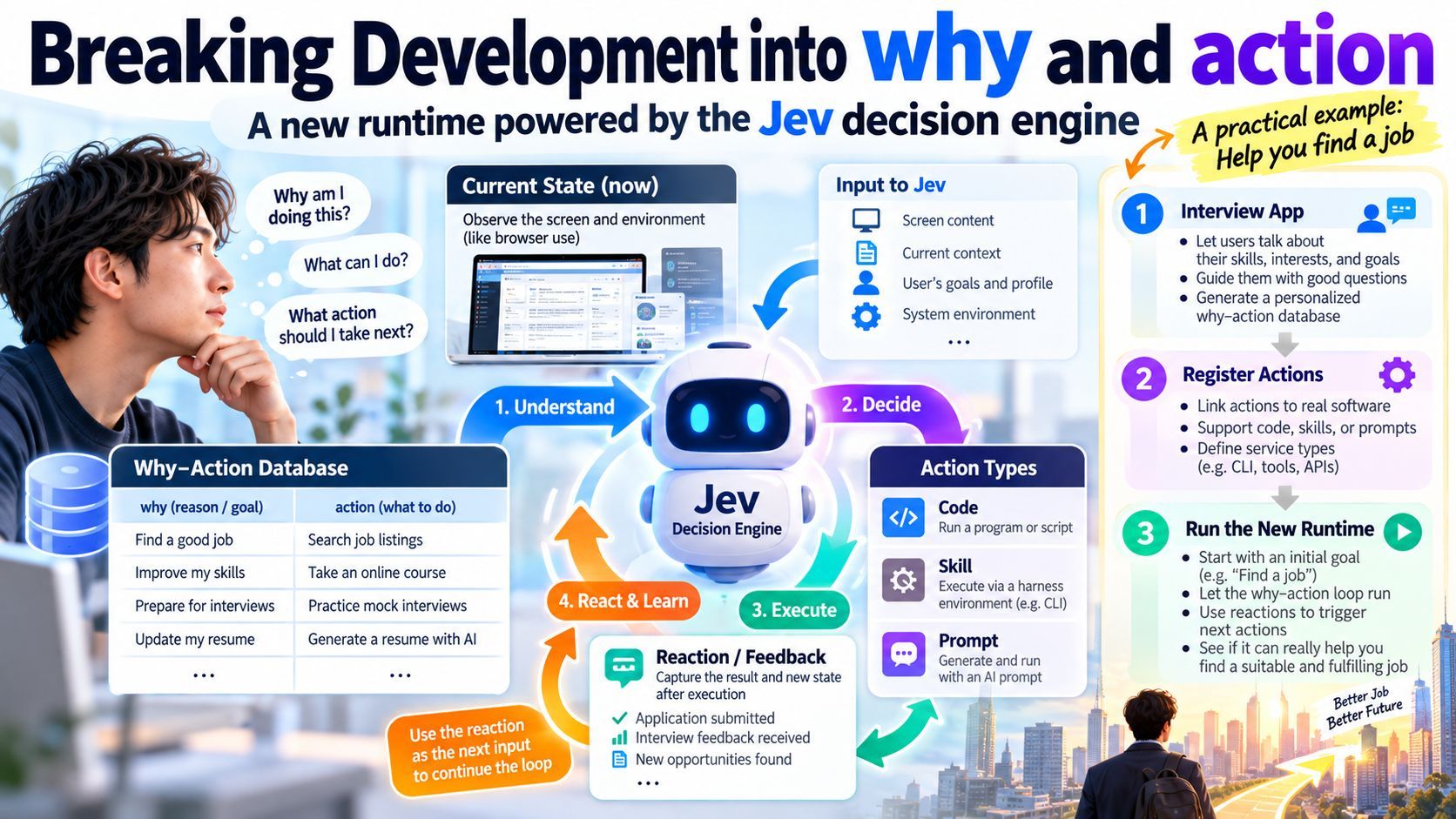
Starting from JVE, a judgment engine that appeared in 2026, this post abstracts development into a key-value pair of why and action and imagines a new runtime driven by the current state: it takes in "now," decides which why-actions to prioritize and in what order, then runs them. A reaction after each action becomes new input that triggers the next Y; browser use watches "now," and an interview helps people build their own why-action database. The scope narrows to a small "find you a job" example in three steps.
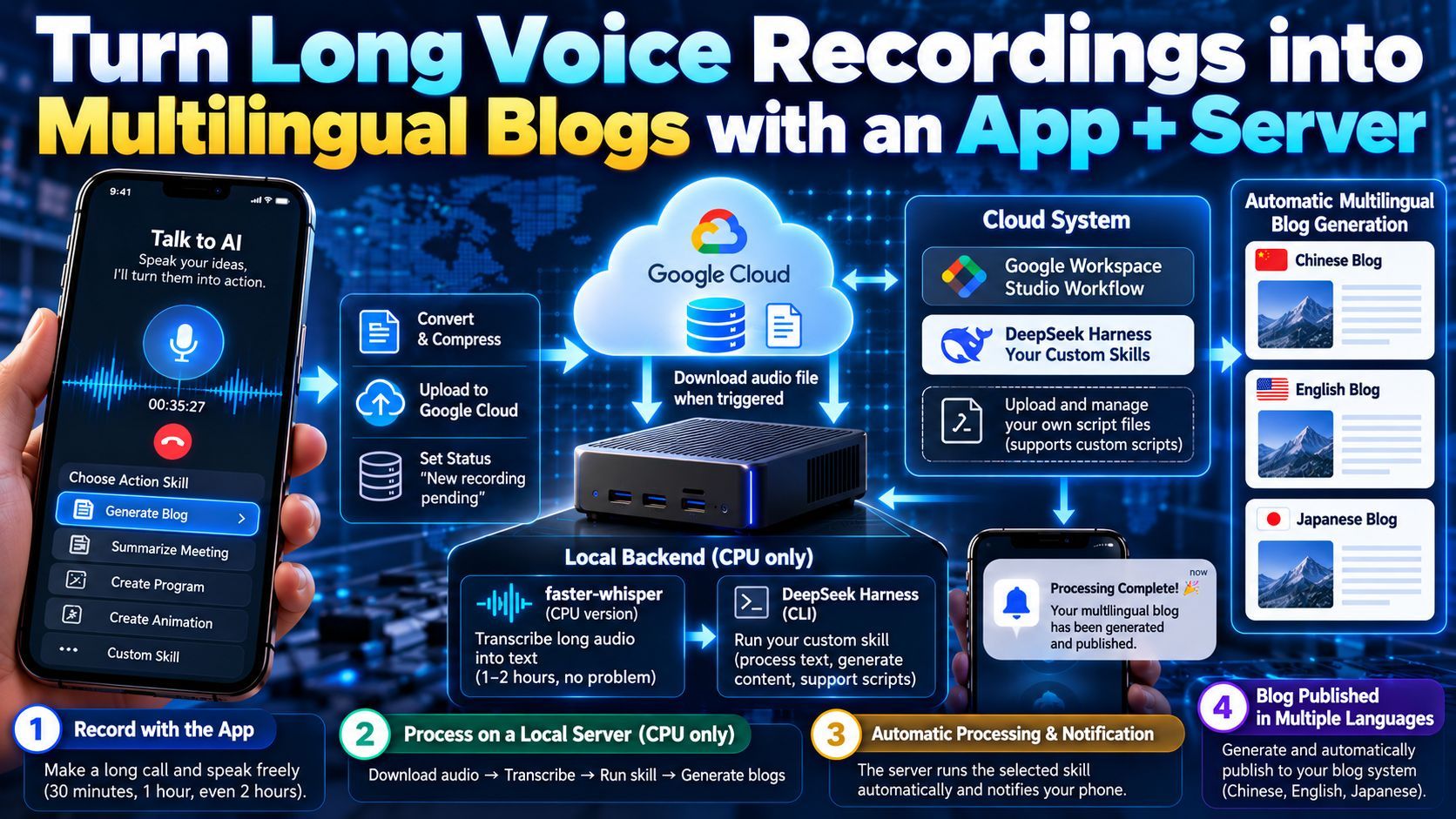
A look at a voice-processing system I built in September from one app plus a set of servers. Long call recordings are compressed and uploaded to Google Cloud, then picked up by a CPU-only, GPU-less machine that runs faster-whisper for speech-to-text and launches DeepSeek Harness as a CLI to run skills. The cloud system lets you upload your own skills and script files, and when processing finishes it notifies my phone while a script converts the content into three languages and posts it to my blog. It matches MUSE and Dota in core functionality while doing long-form transcription on CPU at very low cost. Next up is an automatic decision engine so the system can choose which Action Skills to run and in what order.
I attended the AI Film Hackathon in Tokyo at the Fujitsu Kawasaki Tower and used the AI animation tool Magnific for the first time. It ships with MiniMax H3 series models and Google Flash 3.8 TTS, while an AI Agent automatically operates the canvas to build the Base layer. At a roughly five-hour event I finished seventeen or eighteen audio-driven clips totalling nearly two minutes in under two hours, and the promo CM I made for a pet-care App won an award. I also sense coding agents giving way to more expressive AI products.
A Voice to Action system is complete. It runs on a second-hand, CPU-only PC at home as the server, with an App, the cloud, and Firestore managing state, while Fast Whisper converts speech to text. DeepSeek Harness's DeepSeek Flash model serves as the engine for script-capable skills uploaded from the cloud. Recordings become Japanese, Chinese, and English blog posts that upload automatically through an API — all lightweight and GPU-free.
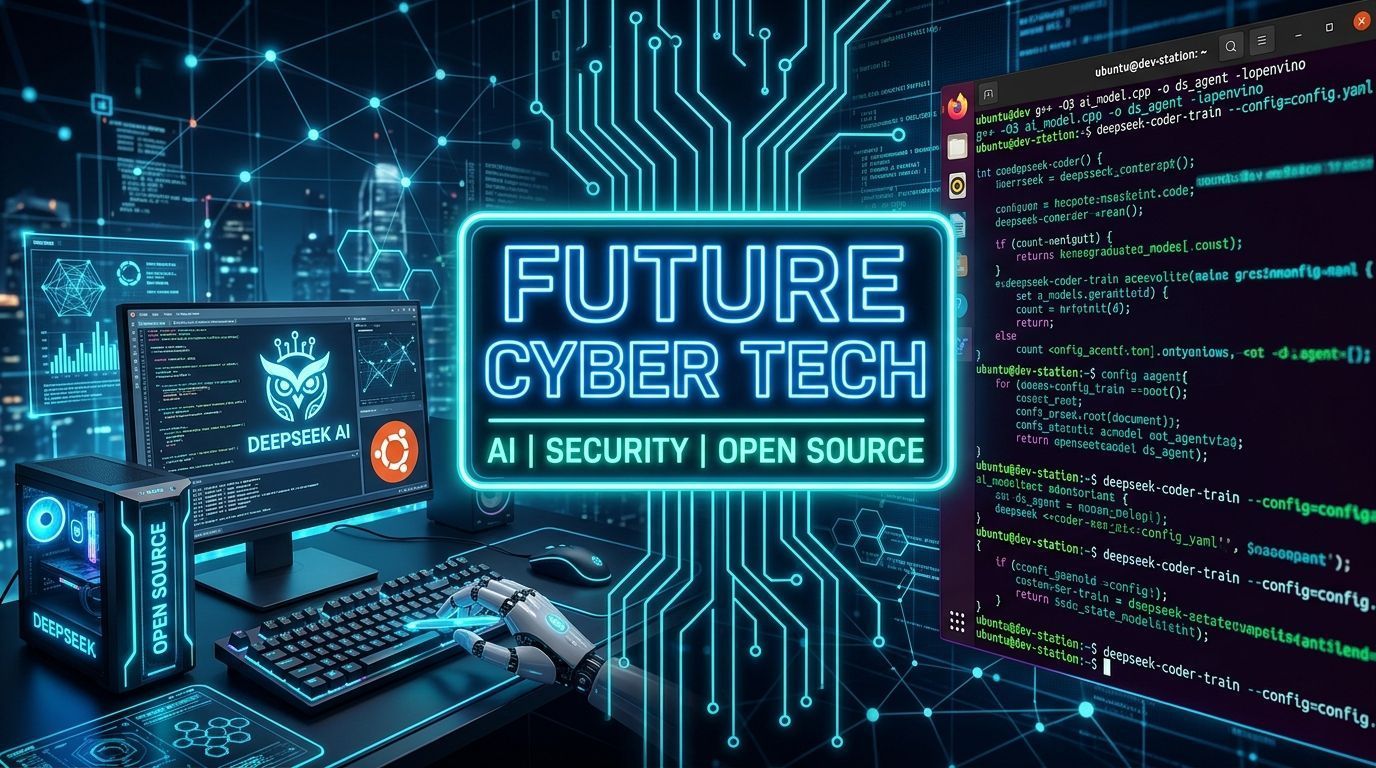
This article addresses the high cost of GPT‑6/Codex development requiring expensive Macs, and offers an alternative: a used PC from Akihabara with Ubuntu and DeepSeek Harness. It provides step-by-step installation instructions, recommended plugins, and future outlook for affordable AI programming (Vibe Coding).
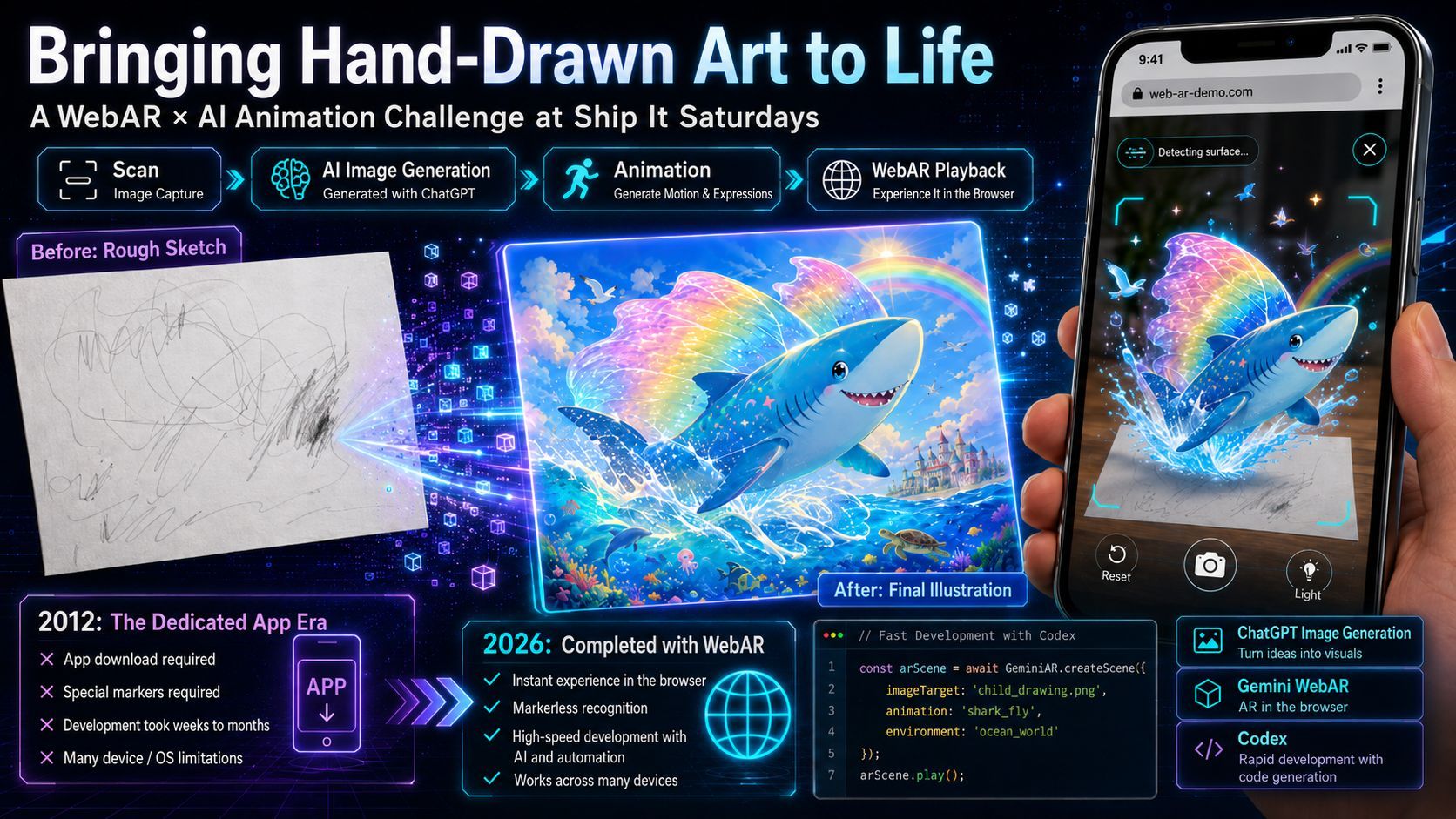
This is my second time participating in this event. During the project, I shifted focus to bringing a child's hand-drawn gift to life through AR animation. By leveraging ChatGPT for image generation and Codex for Web AR development, I completed the implementation in just ten minutes. Comparing this to my research in 2012, the evolution to browser-based, high-efficiency development by 2026 is truly striking. It was a deeply satisfying experience to create this small-scale AR project.