Sony runs six businesses: games, music, pictures, electronics, semiconductors, and financial services. It has not abandoned hardware; it is layering platform fees, copyright licensing, subscriptions, and B2B services on top. Entertainment's share of revenue rose from about a quarter in fiscal 2012 to more than half in fiscal 2022.
This article unpacks the aggregation model: traffic items and headline specials draw shoppers in, while higher-margin categories such as prepared foods and fresh produce capture the attached purchases. Using Life's category margins, it shows why daily-delivered goods make up over 40 percent of sales yet earn little, and examines operating margins at Life and Yaoko, the logic behind industry M&A, and the category-killer alternative.
Companies hire, evaluate, and promote with a single standard, then expect non-standard breakthroughs. Alex Karp argues that the most creative people are often the hardest to manage, because real innovation challenges authority. The article connects that tension to the gap between technology and business value, the role of forward deployed engineers, and why tacit knowledge and judgment become the scarcest assets in the AI era.
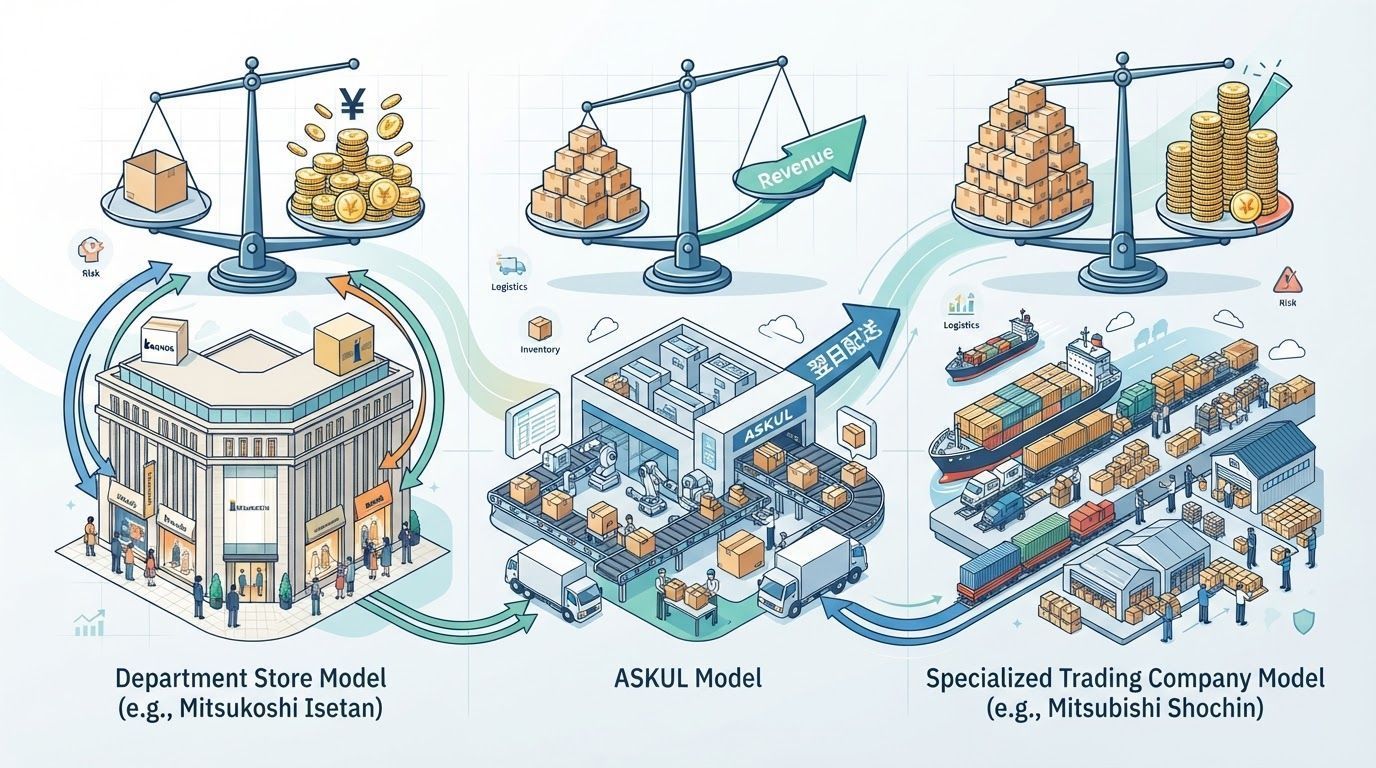
Department stores push inventory risk onto brands through consignment purchasing; Askul holds stock to guarantee next-day delivery while cutting out intermediaries; specialized wholesalers absorb logistics and labor to make thin margins work. Three cases—Isetan Mitsukoshi, Askul, and Mitsubishi Shokuhin—show how who carries each function and risk shapes the economics of distribution.
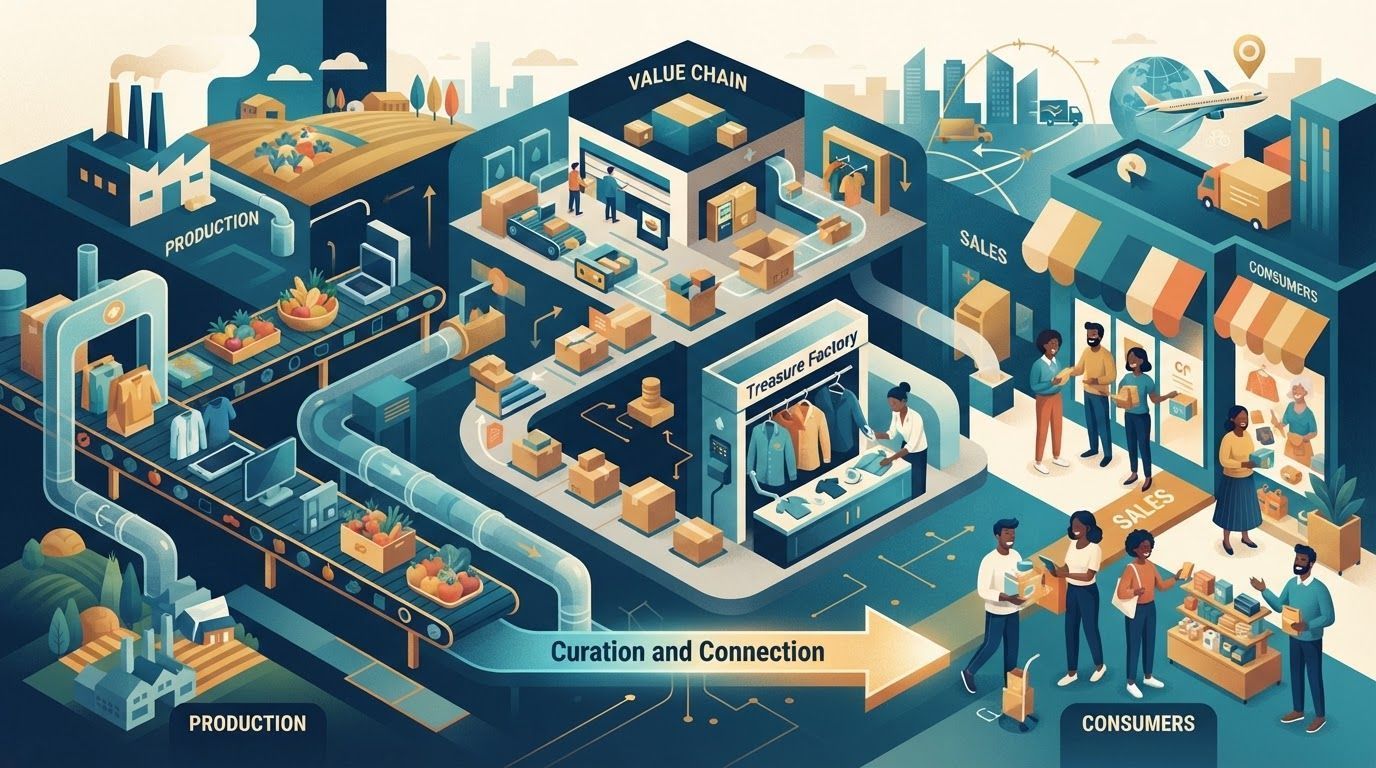
This post breaks down the distribution and retail model: companies make nothing, buy from producers, sell to customers, and earn the spread. It explains the two axes—matching power and the value chain—through Treasure Factory, which cleans and repairs secondhand goods for a 55.9% gross margin. It then examines the model's two weaknesses, easy imitation and thin profitability, and why general supermarkets and trading houses are moving toward combined models.
A month into a new job, the author hits the same wall he left behind: plenty of drive, no outlet for it. He traces the problem to a culture where talk outweighs action—endless arguments, concepts outnumbering shipped products. Drawing on his experience with Japanese clients, he argues for fixing the inside first: daily reporting, joint planning, and solid work before going out to knock on doors. He then pushes further: in the AI era software products are losing value, and the edge moves to cloud partnerships, cross-selling, and the ability to read people, adjust their state, and inspire them through narrative.
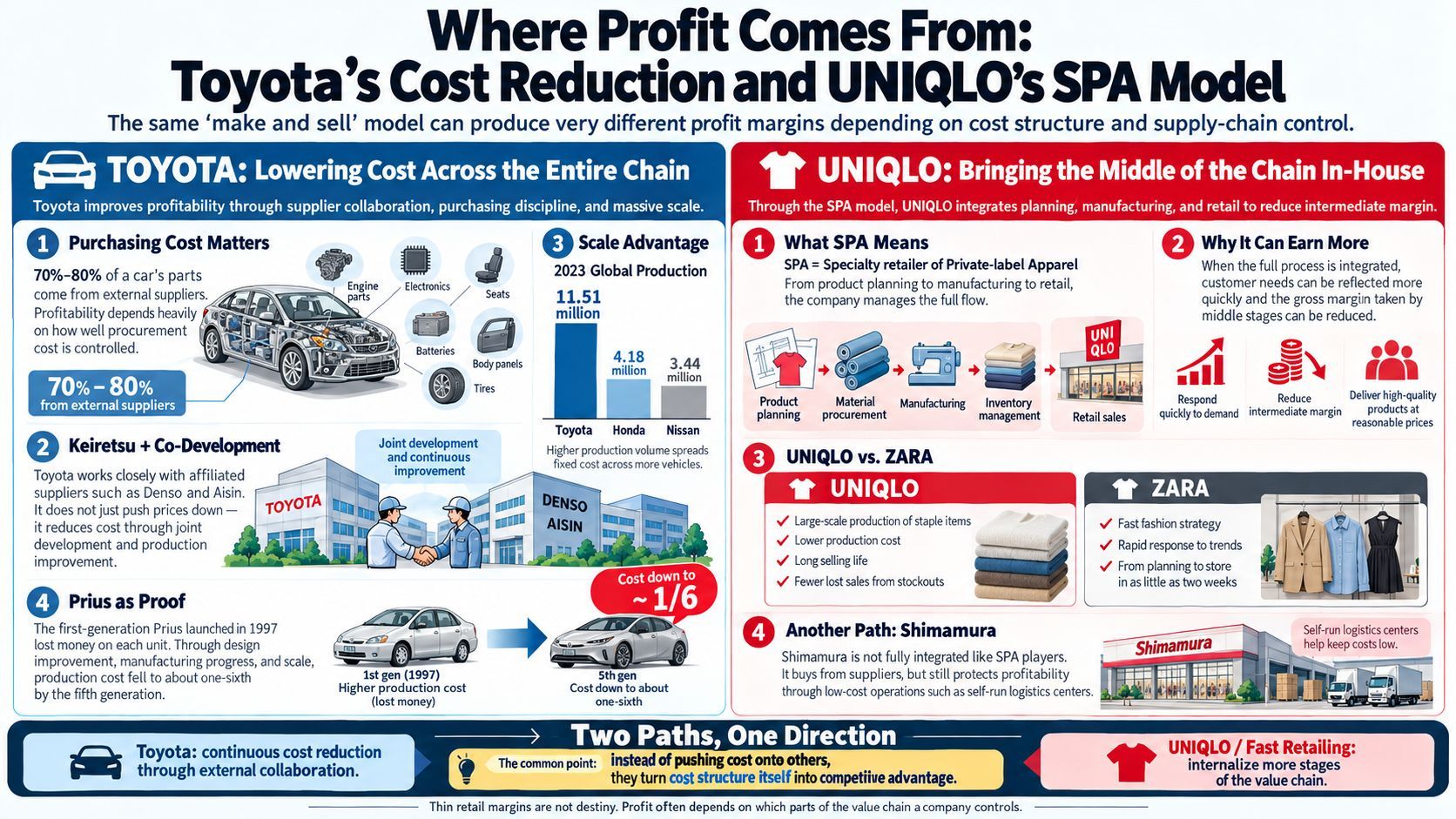
Toyota, Honda, and Nissan run the same manufacturing-and-sales model, yet Toyota's margins are higher. Part of the reason is its commitment to cost reduction while working with keiretsu suppliers such as Denso and Aisin; part is the scale effect of 11.51 million vehicles produced worldwide in 2023. The second case is Fast Retailing (Uniqlo), known for an SPA model that handles planning, manufacturing, and sales in-house, cutting out intermediate margins and reaching global scale with a staple-product strategy opposite to Zara's. This article compares the two industries through one question: how does a company turn its cost structure into a competitive advantage?
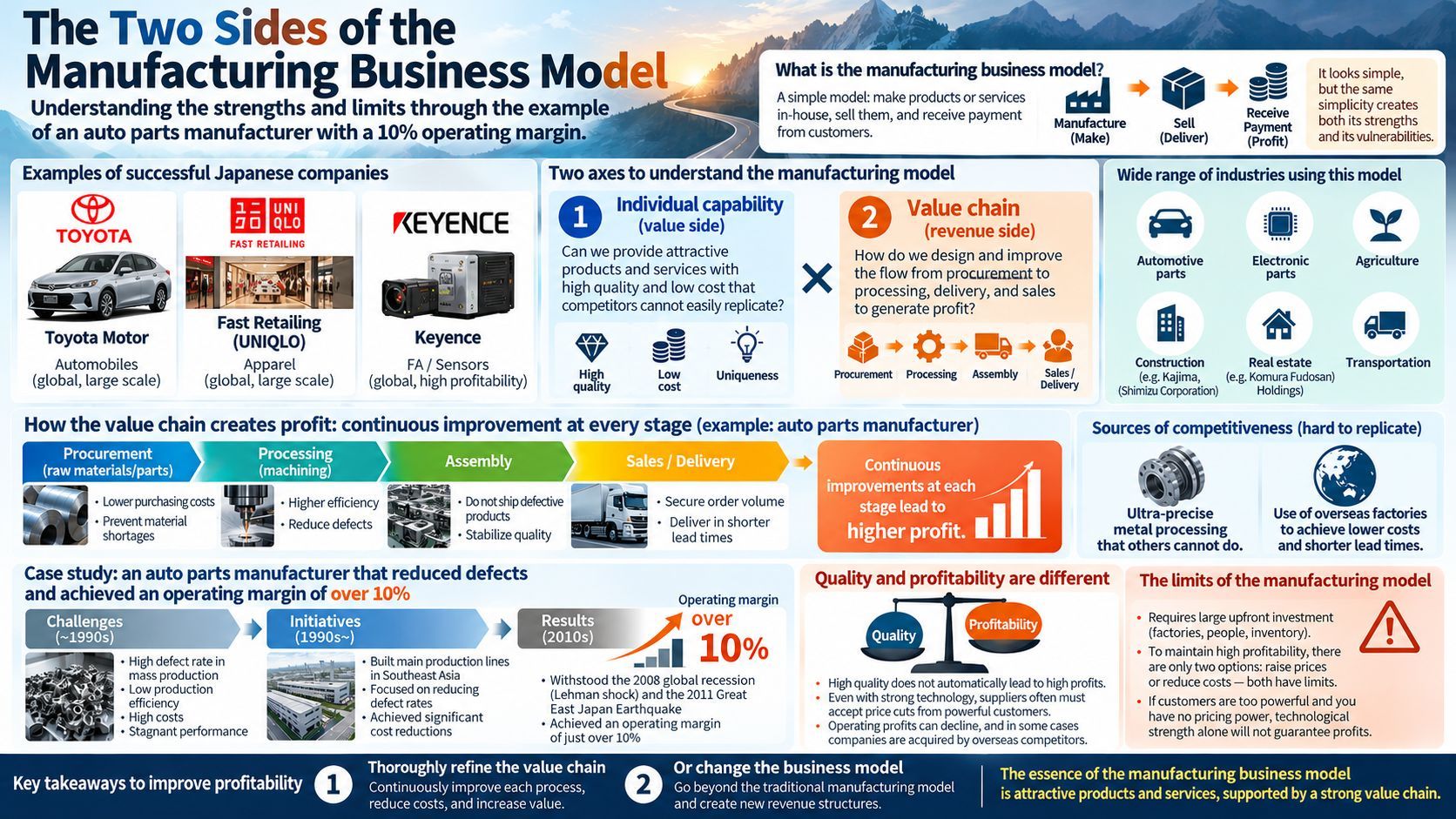
The make-and-sell model looks simple: a company manufactures and sells its own products and is paid by customers. Yet its strengths and its fragility come from the same place. Two axes matter: standalone strength—high quality, low cost, and things rivals cannot do—and the way revenue is earned across the value chain of procurement, processing, and delivery. One ultra-precision parts maker stagnated on mass-production defects, moved its main line to Southeast Asia in the 1990s, and improved defects so thoroughly that it held an operating margin above 10 percent through the 2008 recession and the 2011 earthquake. But quality and profit margin are different things: a supplier that cannot refuse price-cut demands does not recover, and was acquired. The only ways out are to overhaul the value chain or change the model.
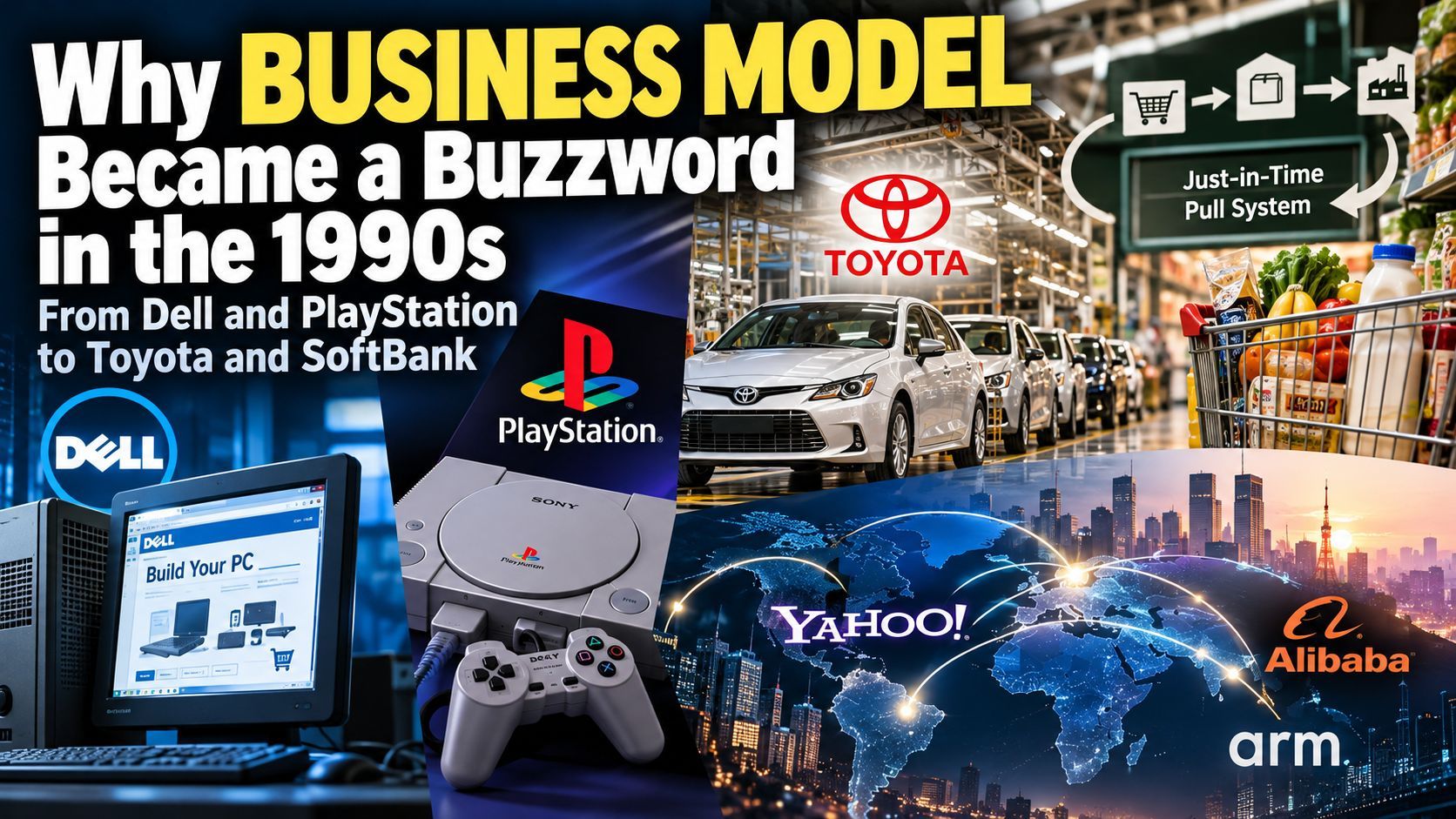
Why did "business model" become a keyword? This article traces the term's earliest uses in the Japanese business press: the 1995 coverage of Dell and its direct sales plus build-to-order model, the 1997 feature on how PlayStation rejected Nintendo's business model, and later talk of an existing model no longer working as Japan's chip industry came under pressure. It then turns to Toyota — the two pillars of Just-in-Time and jidoka, the flaws of push production, the pull system inspired by American supermarkets, and why Ford-style mass production was overkill in Japan. It closes with Masayoshi Son's time machine management and the idea that there is no single right angle on a business model.
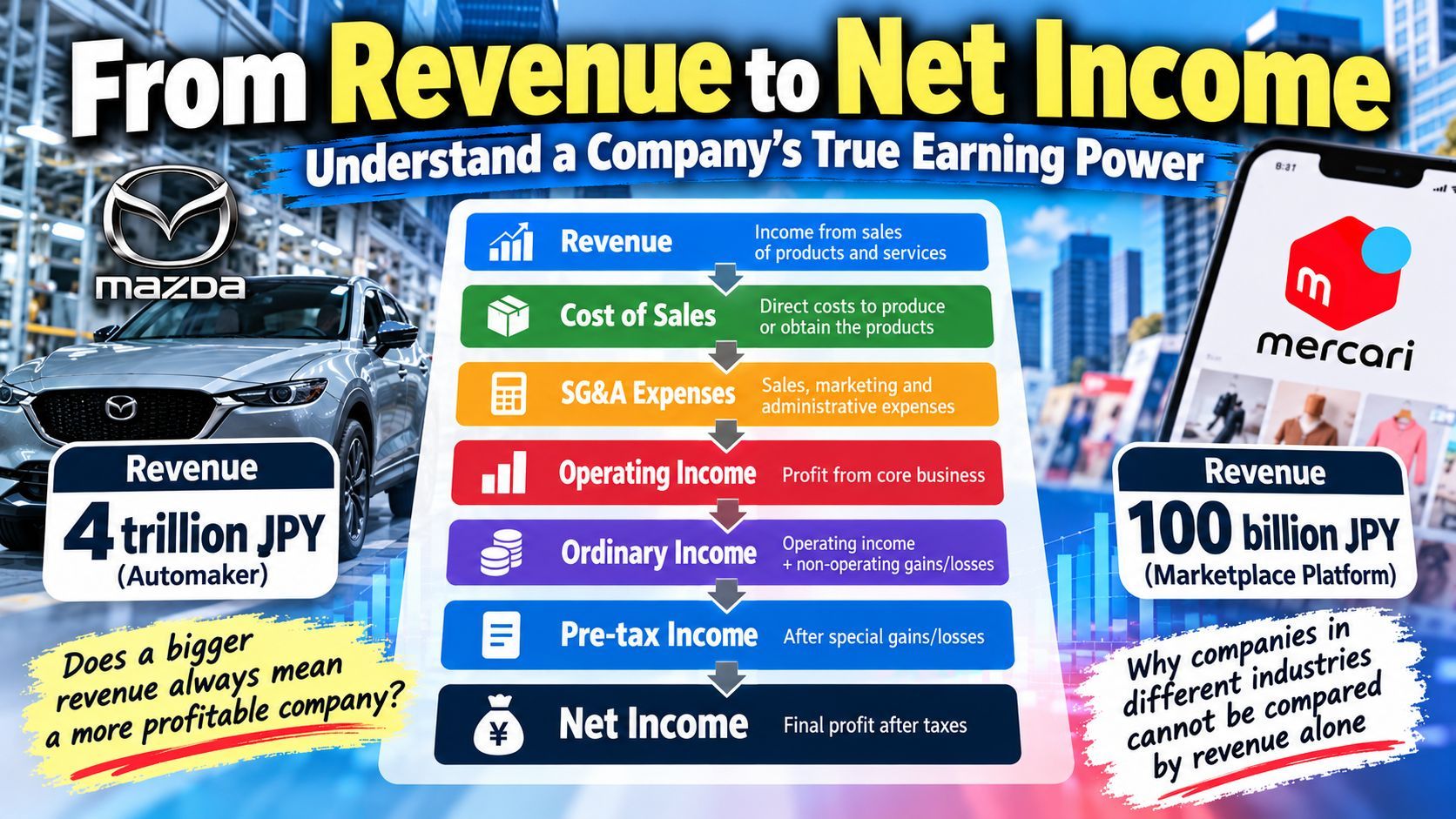
Higher revenue does not necessarily mean stronger earning power. This article moves from revenue, cost of sales, and SG&A down to operating profit, then through the five profit layers of the income statement: gross profit, operating profit, ordinary profit, pre-tax profit, and net income. Using Mazda and Mercari, it explains the gross-versus-net revenue distinction, along with gross margin, restaurant FL cost, why industries emphasize different profit measures, and how EBIT and EBITDA work. The lesson: compare companies by understanding the business model and accounting basis behind each number.
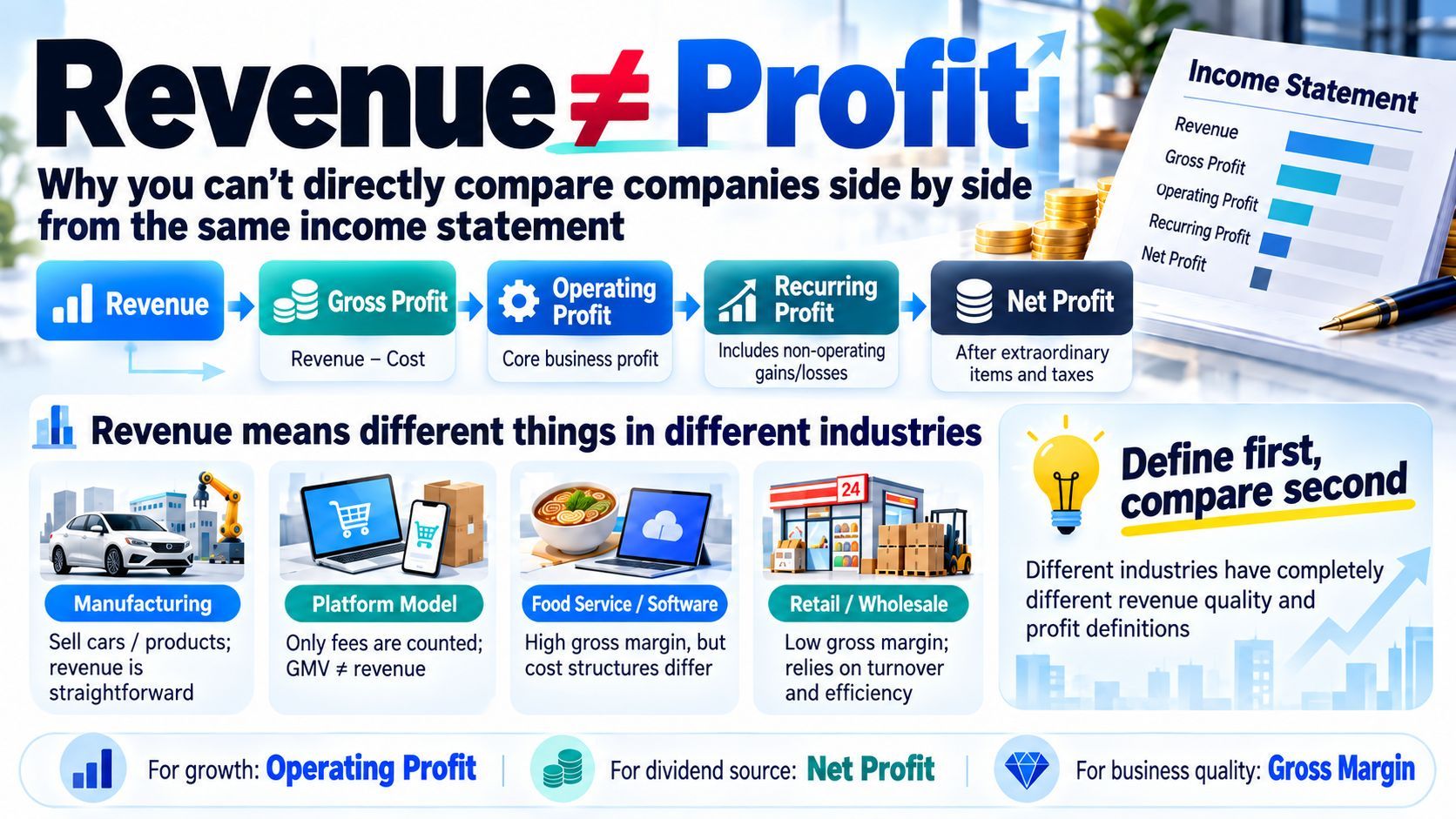
Revenue and profit are the go-to numbers for comparing companies, yet how they are calculated differs sharply by industry and by company. Using manufacturing as an example, this article walks through the ladder from revenue, cost of goods sold, and SG&A to operating profit, ordinary profit, and net profit. It then shows how much revenue can differ in substance, from Mercari booking only its roughly 10 percent commission to construction's revenue recognition and the unpredictable earnings of securities and game companies. It explains the three sources of high gross margins and why trading companies watch net profit, Nippon Yusen watches ordinary profit, and SoftBank Group watches NAV, along with business profit, EBITDA, and EBIT.